

Quick Answer
Dear Stacy, Edition 3: A $9 Splurge and an AI Turtle. Stacy Jones answers letters about the moment a business suddenly becomes the story.
Dear Stacy: From the Office of WTF · Edition 3
This week a coffee chain owner learns that customers listen to investor podcasts too, and a '90s pizza shop's AI turtle starts a fight its owner keeps finishing. Then a streetwear founder wants to know how one movie jacket made everyone want in.
In this edition
- Letter 1: I Called Our $9 Latte a Splurge. On a Podcast.
- Letter 2: My Cartoon AI Takes the Orders and I Take the Bait
- From the Set: Everyone Wants Our Jacket for Free. How Do I Make Them Want It for Real?
Letter 1 I Called Our $9 Latte a Splurge. On a Podcast.
Dear Stacy,
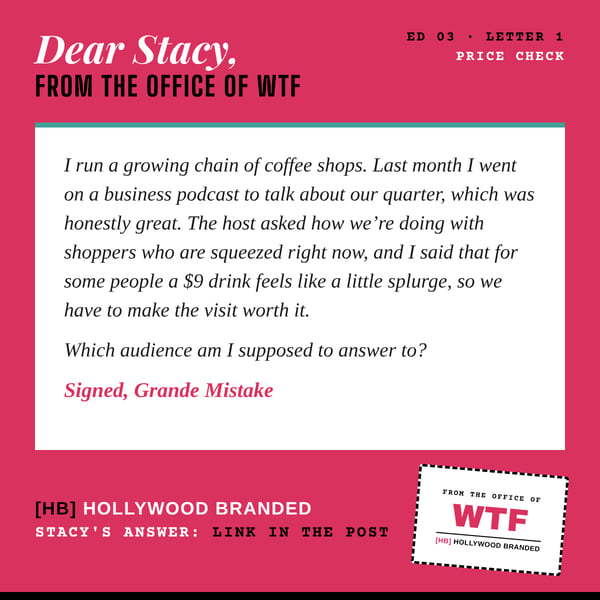
I run a growing chain of coffee shops. Last month I went on a business podcast to talk about our quarter, which was honestly great. The host asked how we're doing with shoppers who are squeezed right now, and I said that for some people a $9 drink feels like a little splurge, so we have to make the visit worth it. I meant it as a compliment to our baristas. By the weekend, a clip of me was making the rounds with captions calling me out of touch, and people in our comments were posting their grocery receipts. Our investors loved the interview. Our customers are making memes about it. Which audience am I supposed to answer to?
Signed, Grande Mistake
Dear Grande,
You answer to both, and you have to assume your customers are listening every time you talk to investors. They are now.
Starbucks CEO Brian Niccol went on the Wall Street Journal's What's News podcast in early May and was asked about the K-shaped economy. He said a $9 visit can feel like a splurge, so Starbucks has to make it worthwhile, and that for some people a ticket under $10 is an affordable premium experience. Social media called him out of touch and boycott calls resurfaced. The Guardian ran an opinion piece and the Daily Beast called the comments tone-deaf, according to Sprudge.
Wall Street heard something different. The same week, Starbucks reported fiscal second-quarter revenue of $9.5 billion, up 9%, with global comparable sales up 6.2% and the stock up about 24% for the year. Fortune found no direct company response to the backlash.
He got the substance right. The point under the quote was that a higher price has to be earned with a better visit, and Fortune reported Starbucks is putting about $500 million into staffing, barista training and store upgrades. That is a customer story.
The vocabulary is where it went wrong. "Splurge" describes the customer's budget. When someone who is stretching to pay hears a CEO call that stretch normal, it lands as a comment about them. You meant yours as a compliment to your baristas. It does not matter what you meant. It matters what they experienced, and that is the whole job of Perception Control. Sprudge made a fair point that his sentence was about a premium experience at an affordable price. Clips do not come with punctuation.
I have watched plenty of executives carry investor vocabulary into a room full of customers, and the clip tends to outlive the context. If your prices went up, explain what the customer gets for the money, in the words they would use. Keep "average ticket" and "splurge" in the board deck.
The Move
Write your price story in customer language this week, before someone clips you telling it in investor language.
The Value: Perception Control · Chapter: Price Check
Parody letter inspired by reporting from Fortune and Sprudge. The letter writer is fictional.
Letter 2 My Cartoon AI Takes the Orders and I Take the Bait
Dear Stacy,
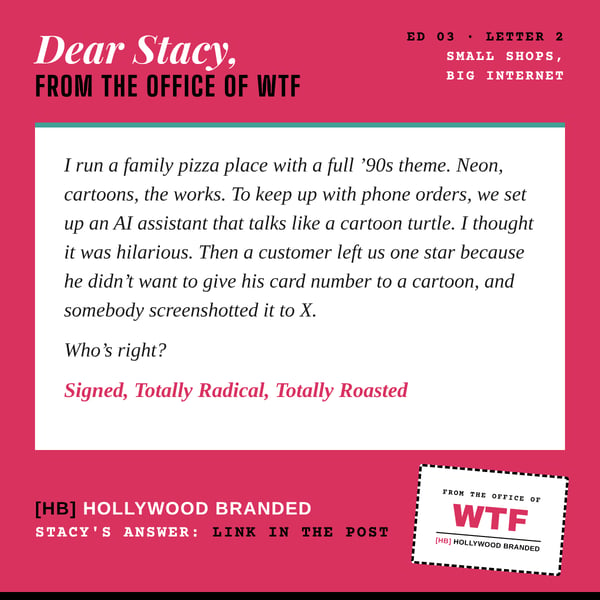
I run a family pizza place with a full '90s theme. Neon, cartoons, the works. To keep up with phone orders, we set up an AI assistant that talks like a cartoon turtle. I thought it was hilarious. Then a customer left us one star because he didn't want to give his card number to a cartoon, and somebody screenshotted it to X. Millions of views later, strangers are dumping one-star reviews on us. I've been answering every one of them. Some of my replies were, let's say, very '90s. My kids say I should stop. My regulars say I'm a legend. Who's right?
Signed, Totally Radical, Totally Roasted
Dear Totally,
Your kids are right. Stop replying today. The phone assistant started the conversation, and your replies are the reason it kept going.
Cowabunga! Pizza Pies, a family-owned, '90s-themed shop in Chicago, lived this in September. A one-star Google review from a customer who did not want to give card details to "AI Michelangelo" was screenshotted and shared on X, and Dexerto says the posts drew millions of views. The shop's reply to that review opened with "Cool story bro! Welcome to the future!" Other reviewers who complained about the pizza or coupons were called "dorks," "morons" and "dumb." Reaction split, with some people laughing and plenty angry about AI handling customer service. The coverage I read includes no statement from the shop.
The assistant may not have been the real problem. A writer at The Mary Sue called the line and found it identified itself as a virtual assistant, texted a secure payment link instead of taking card numbers by phone, and offered to connect callers to a person. That is a defensible setup. One friendly reply explaining it could have turned the attention into orders.
I have watched businesses lose arguments they were winning for 30 years, and it almost always happens in the replies. A review response is an ad written for the next customer. An insult tells that customer exactly what happens if they ever complain.
I run my company on No Ego, No Drama, and it matters most on the days someone gets under your skin. Every reply that defends your pride costs you a customer who never complained.
Pin a short explanation to your profile covering how the assistant works, that it never takes card numbers, and how to reach a human. Answer only real customers, calmly, and report the pile-on to the platform.
Keep the theme and keep the jokes. Aim them at the pizza, never at the person who paid for one.
The Move
Pin one calm explanation of how your AI works and how to reach a human, and never reply to a review while you are still annoyed.
The Value: No Ego, No Drama · Chapter: Small Shops, Big Internet
Parody letter inspired by reporting from Dexerto and The Mary Sue. The letter writer is fictional.
✦ From the Set ✦ Everyone Wants Our Jacket for Free. How Do I Make Them Want It for Real?
Dear Stacy,
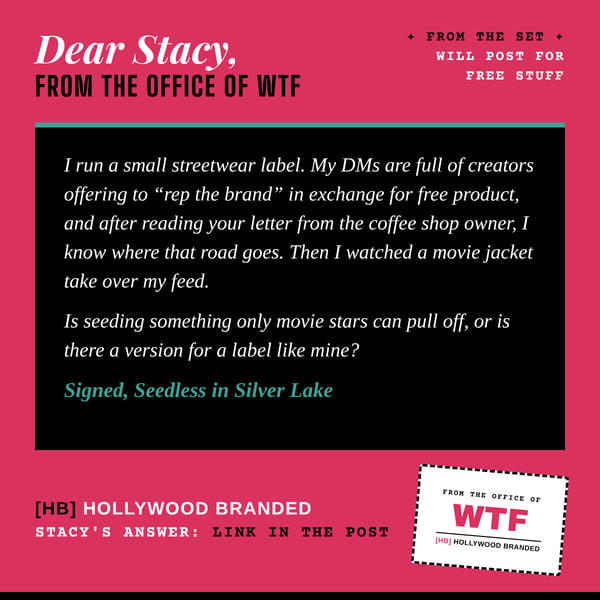
I run a small streetwear label. My DMs are full of creators offering to "rep the brand" in exchange for free product, and after reading your letter from the coffee shop owner, I know where that road goes. Then I watched a movie jacket take over my feed. Famous people in the same windbreaker, a line around the block for a pop-up, resale prices I can't type with a straight face. Nobody asked for those jackets. They were handed out. I have a marketing budget the size of a lunch order and one really good jacket. Is seeding something only movie stars can pull off, or is there a version for a label like mine?
Signed, Seedless in Silver Lake
Dear Seedless,
There is a version for you, and it starts with flipping who does the asking.
Look at the Marty Supreme jacket. Ahead of the film's Christmas Day 2025 release, Los Angeles designer Doni Nahmias made a limited windbreaker, and Timothée Chalamet reportedly hand-picked who got one, according to The Zoe Report, which cited Nahmias's comments to WWD. The people photographed in it ran from Kylie and Kendall Jenner and Hailey Bieber to Tom Brady, Steph Curry and Bill Nye. When the public got a shot, PPAI reported that the $250 jacket sold out in about 15 minutes, and a New York pop-up announced with a single Chalamet post drew a line more than five blocks long. The Zoe Report cited StockX listings above $6,000. Nothing I read says any wearer was paid, so I am treating it as gifting.
Joseph Sommer, CEO of promotional products distributor Whitestone, told PPAI the team was really handing out early access to the film's world and a sense of belonging. That is the part your label can copy. Brands buy cultural association, not screen time, and that jacket was pure association.
A freebie someone asks for is a transaction, and the person asking sets the terms. A gift you choose to send, to a short list, is a signal. The person who gets it feels picked, and everyone who sees it wants in. Passion is what makes that signal work. A handwritten note and no ask tell the person you care about the piece and about them, and people can feel when a label loves what it makes.
For a label your size:
- Make a small run of one piece just for seeding.
- Pick 15 to 20 people whose audience you actually want, and send it with a handwritten note and no posting requirement.
- Decline the inbound "free product for a post" requests.
- Open a short, limited sale once people start asking where to get it.
Some recipients will not post. That is the cost of making it feel real.
The Move
Stop answering the people who ask for free product and start choosing the people you would be proud to send it to.
The Value: Passion · Chapter: Will Post for Free Stuff
Parody letter inspired by reporting from PPAI and The Zoe Report. The letter writer is fictional.
Office Hours How to Announce a Price Increase
A price message can go sideways in one sentence, as the $9 latte letter shows. Raising prices is normal. Announcing it badly is what turns into a screenshot. Before any price change goes out, I would check five things:
- Lead with what the customer gets. The better visit or the faster delivery. Then the number.
- Show the old and new price in one plain line, and have a second person check it against your actual price list.
- Give the reason in one sentence, in customer words, and only if it is true.
- Tell people before it hits their card. Subscribers should hear it with time to pause or cancel.
- Brief everyone who answers questions, including any AI agent, on what changed and when to hand off to a person.
This is Clear Communication with money attached. A client who knows what is happening forgives a lot more than a client who is guessing, and customers work the same way.
The Office of WTF Verdicts
Starbucks CEO's "$9 splurge" comment
Who fumbled: The CEO's word choice, built for investors
Who won the perception game: Wall Street, for the quarter
Lesson: Customers hear the investor interview too. Tell your price story in their words.
Cowabunga! Pizza Pies and its AI phone line
Who fumbled: The shop, in its review replies
Who won the perception game: The commenters, who got a better story than the shop told
Lesson: Reply for the next customer, and never insult the last one
The Marty Supreme jacket
Who fumbled: Nobody
Who won the perception game: The film's merch, gifted to a hand-picked list before anyone could buy it
Lesson: Free product works when you pick the recipient
The thread this week: Every one of these stories turned on who was listening. The podcast clip and the review replies reached audiences nobody planned for, and the jacket worked because the people behind it picked the audience first.
✦ From the Office of WTF ✦
Real letters from the moment a business suddenly becomes the story, and what to do next.
Every letter comes back to owning the next choice. That is the heart of Dragons & Doors, my parable about accountability. If one of these letters felt familiar, the book goes deeper.