Quick Answer
Streaming romance fandoms are brand gold. See how Verizon, Peloton, and more are casting heartthrobs to drive viral campaigns and real results.
The New brand face has a fandom first
In the world of new releases, there has been no shortage of romance series hitting our screens. And if you are like me, and obsess over not only the show but the actors, then you may or may not have noticed that these heartthrobs start to appear, well, everywhere. And I am not talking in just a normal press promotion tour kind of way. These celebrities are showing up not just in Hollywood, but in brands. Forget bug-name athletes, social media influencers, or A-list movie stars with decades of name recognition. There is a new kind of celebrity deal happening in Hollywood, and it is all about fresh-faced heartthrobs. The brands making the most noise right now are the ones casting the faces you just saw on your streaming queue last weekend, the ones you see edits for online.
What these actors share is not just good looks or a hit show. They come pre-loaded with something far more valuable to a brand: a passionate, digitally native audience that is already emotionally invested in them. In this article, Hollywood Branded explores the rise of the streaming heartthrob as brand spokesperson and what this trend means for marketers who want to tap into fandom as a deliberate strategy.

Streaming Fandom Audiences and Why Brands Are Taking Notes
To understand why brands are rushing to cast these actors, you first have to understand what is happening with romance streaming shows right now, because it is genuinely unlike anything we have seen before. Shows like Heated Rivalry and Off Campus are not just performing well on their platforms; they are taking on a life of their own entirely. And a big part of that is social media. There is a real community element to the way fans engage with these shows now. People are not just watching, they are creating and/or watching fan edits, discussing their favorite tropes, and building entire corners of TikTok around the cast. These show get dissected, celebrated, and gets shared with every person in your life you can convince to watch it.
A huge part of what fuels that obsession is the fact that so many of these shows are book adaptations. Both Heated Rivalry and Off Campus started as beloved novels with dedicated readerships before a single frame was ever filmed. That means by the time the show drops, there is already a passionate, invested audience waiting for it, one that has spent months or years imagining these characters and these stories. And then new viewers come in through the show and get pulled straight into that same world. Add in the fact that romance as a genre runs on tropes you know, enemies to lovers, fake dating, friends to lovers, secret feelings. Everyone has a favorite, and these storylines just make fans that much more invested.
The studios know exactly what they are doing too. Successful press tours, active social accounts, behind-the-scenes content, cast interactions that feed the fandom machine, it is all intentional, and it all adds up to an audience that is primed, engaged, and incredibly loyal.
The result is not just that they perform well, but they become full on pop culture moments.
And here is the thing: that loyalty does not stay contained to the show. It transfers. When fans fall for a character, they fall for the actor too, and anything that actor becomes a part of gets pulled right into that same orbit. And that is exactly when brands start paying attention.
.png?width=1200&height=675&name=Sarah%20F%20BLOG%204%20COVER%20IMAGE%20-%202026%20(2).png)
Verizon: Taking Streaming Stars From Your Screen to Theirs
If there is one campaign that perfectly captures this trend, it is Stephen Kalyn for Verizon. Kalyn, who appears in Off Campus and is set to step into the leading role for the highly anticipated Season 2, was tapped by Verizon for their "Simplicity Is Sexy" campaign, and the casting was anything but random. Marking his first major brand deal since Off Campus, Campaign US called Kalyn "culture's latest obsession," and Verizon clearly agreed. The ad was deliberately evocative of iconic Calvin Klein campaigns, even bringing in director Bardia Zeinali, who directed Calvin Klein's "Deal with It" spot, and the creative direction absolutely shows. But here is the thing about casting someone like Kalyn: people actually want to watch the whole thing. He also voices the ad, which means fans are not just going to want to watch it. They are going to be actively both watching and listening to the video, and by extension, Verizon's messaging.
And the organic response has been something else entirely. Not only are people rewatching and sharing it, fans have actually started making edits of it. You heard that right. TikTok filled up almost immediately with fan edits pulling clips straight from the Verizon spot, set to music, captioned with things like "everyone say thank you to Verizon." Fans were even tagging Verizon directly with things like "thank you for your service." Verizon saw exactly what was happening and leaned right into it, responding with their own TikTok captioned "Heard you wanted more of Stephen Kalyn and Verizon Dollars," giving the brand a personality and a voice that fans actually responded to. Bottom line: fans are making edits of a Verizon ad, which tells you everything you need to know about how powerful the right casting decision, paired with strong creative direction, can be.
My first thought upon seeing the ad, beyond excitement for seeing Stephen Kalyn on my screen, was why would Verizon choose him? He is going to largely appeal to Gen Z. Then I realized there is a larger play here worth noting. As Gen Z grows up, they are getting their own phone plans and making their own purchasing decisions. They are now a part of Verizon's demographic targeting, and Verizon just made itself extremely relevant to that exact audience.
Worth noting too: Kalyn was not Verizon's first play. Earlier this year in the same campaign cycle they cast Connor Storrie, the lead of Heated Rivalry, for a short film spot. And the Storrie spot was pretty different in tone. Verizon tapped director Nia DaCosta for a comedic horror-spoof short film titled "Look Behind You." What made it work was how deeply Verizon did their homework. The team spent time, as Verizon CMO Leslie Berland put it, "listening and understanding what his fandom has been tracking, what they're excited about." That even extended to Easter eggs in the creative, like setting the film at a remote cottage, a nod that Heated Rivalry fans immediately recognized. They clearly yielded successful results; Videos associated with the campaign racked up about 35 million views.
The common thread is simple: cast the fandom-beloved man that the internet is obsessed with. And Ad Age put it best, noting that Verizon is "carving out a hockey hunk-focused marketing niche." Because here we see two shows, two fanbases, two completely different creative approaches, and one very deliberate strategy. Verizon went back to the same fandom well twice, which says everything about how well this strategy landed.
Photo Credit: Verizon YouTube
Peloton Did God's Work, and the fans agree
This may be my most recent example, but it is certainly not the first. I mentioned Connor Storrie for Verizon, but co-lead Hudson Williams has certainly been dominating the pop culture, and brand, scene as well. Hudson Williams, the breakout star of Heated Rivalry, became the face of Peloton's "Let Yourself Go" campaign, a continuation of the brand's platform built around reframing fitness as release instead of obligation. Directed by Bethany Vargas, who also directed Lady Gaga's "Abracadabra" music video, the spot features Williams dancing, strutting, and working out to David Bowie's "Fame." The ad does not shy away from Williams's magnetism, leaning into his physicality and undeniable charisma through sweat, movement, and confidence. Peloton CMO Megan Imbres called Williams a "no-brainer" for the role, and that instinct proved correct because the internet noticed immediately.
The timing mattered too. Imbres was candid about what she was actually chasing with the campaign, and it was not just numbers. "It is a feeling," she said. "You feel it, and you see everyone talking about it... There's an intangible piece to really good marketing that is not just a number, it's something that you feel connected to." And honestly, she is spot on with that sentiment. The ad has racked up over 20 million views on YouTube alone, and Peloton's stock climbed more than 3 percent the day after it dropped, a meaningful jump for a brand that had been dealing with a rough quarter.
And just like the Kalyn ad, this one took on a life of its own. Fans were not just watching, they were obsessing. TikTok filled up with edits of Williams set to music, captioned with things like "Peloton did God's work." Safe to say fans were pretty obsessed. The Heated Rivalry hashtags were everywhere underneath it, proof that Peloton was not just borrowing Williams's face, they were borrowing his entire fandom. It is worth pointing out, too, that this is not new territory for Peloton. The brand has tapped into pop culture moments before, including a well-remembered Stranger Things collaboration, and clearly understands that the right cultural attachment can be truly successful for a brand.
 Image Credit: The Hollywood Reporter
This is Bigger than TWO Brands
By now you might be thinking this is just a Verizon thing, or a hockey romance thing. It's not. The same exact playbook is showing up across totally different brand categories, which tells you this is not a one-off trend, it is a full blown strategy. Take Christopher Briney, who plays Conrad Fisher on The Summer I Turned Pretty and has spent three seasons at the center of one of the most talked about love triangles on television. Panera Bread leaned directly into that storyline for their "You Pick 2" campaign, casting Briney in an ad where he broodingly declares he is "torn between two things," only for the punchline to reveal he is simply deciding between a salad and a sandwich. Fans immediately recognized exactly what Panera was doing and loved them for it, flooding the comments with things like "genius marketing" and "marketing team needs a raise asap." Briney has also walked in a Calvin Klein NYFW show, further proof that fashion and lifestyle brands see exactly what Verizon and Peloton saw.
And then there is Belmont Cameli, who plays the lead in this breakout season of Off Campus as team captain Garrett Graham, the same show that introduced us to Stephen Kalyn. Reebok just named Cameli their newest global brand ambassador in a multi-season partnership built around the brand's "Born Classic. Worn for Life." platform. The brand explicitly credited "the roaring success" of Off Campus as the driving force behind the deal. The campaign itself was shot candidly on the streets of Los Angeles, leaning into an authentic, off-duty feel rather than something overly polished, which is exactly the kind of approach that resonates with an audience who appreciates the actor themselves.
 Image Credit: WWD
And then there is Quinn, an audio erotica app that has taken this entire strategy and made it the core of its business model. Quinn founder Caroline Spiegel reached out to Connor Storrie and Hudson Williams's teams after seeing the trailer for Heated Rivalry, before the show had even premiered or HBO Max had finalized distribution. The resulting series, Ember & Ice, became Quinn's most listened to project to date, racking up 39 million minutes of listening time. Other streaming stars to partner with Quinn include Christopher Briney, Tell Me Lies' Costa D'Angelo, Emily in Paris' Lucien Laviscount, Stranger Things' Jamie Campbell Bower, and, in one of the latest additions, Off Campus favorites Allie and Dean, played by Mika Abdalla and Stephen Kalyn.
Spiegel told the Wall Street Journal, "If you're a popular 'thirst' celebrity, you're going to have your voice be haphazardly AI replicated and have thousands of fan fiction stories written about you in the depths of the internet, so might as well do it right and do it your way." That is the whole trend summed up in one quote. The fandom already exists, the only question is which brand gets there first.
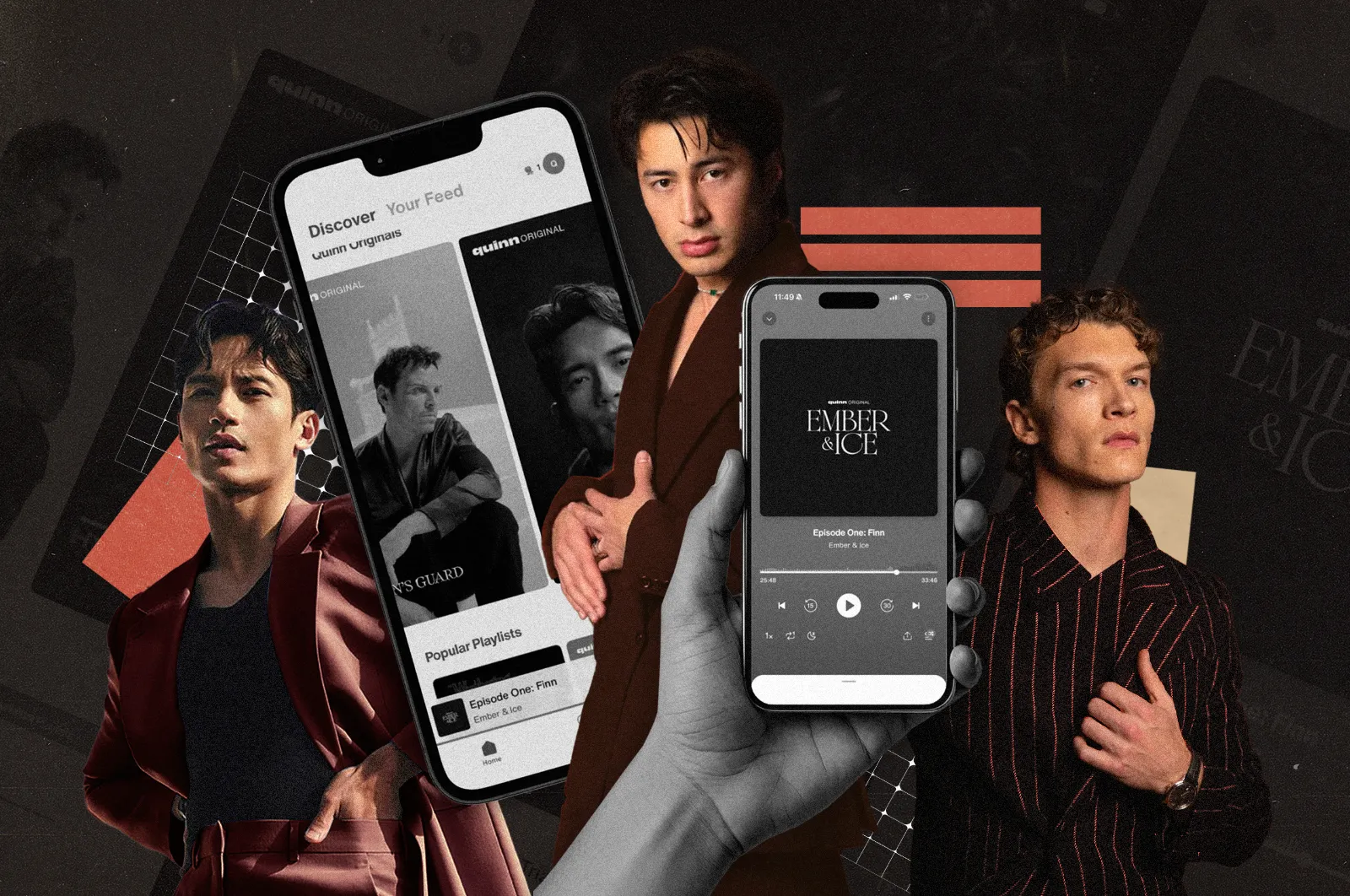 Image Credit: Rolling Stones Philippines
And it is not just individual brands either. Prime Video is very well aware of this entire world they have orchestrated. They just hosted Obsessed Fest, an entire fan event built around its roster of streaming romances, with stars from Off Campus, Maxton Hall, Every Year After, and Your Fault: London, to name a few, all making appearances. When the platform behind these shows starts throwing dedicated fan festivals, you know the fandom to brand pipeline has officially become the strategy, not the exception.
So just with this, we see five different brands across five different categories: telecom, fitness, fast casual, footwear, and audio entertainment. One very clear pattern. When a streaming romance creates a devoted fandom, brands are not just taking notice, they are actively building entire campaigns around borrowing that built-in audience that they know is going to show up and amplify.
 Image Credit: Just Jared

The Smartest Brand Casting Is Happening in Streaming Right Now
By this point, the pattern is pretty hard to ignore. This is a consistent trend we are seeing across brand strategy, and it is only getting bigger. All these brands I covered – they were paying attention. And in this industry, paying attention – especially early – is everything. Once a show goes viral, of course everyone is going to want to tap that actor. The bidding gets competitive, the window gets smaller, and the moment starts to feel less organic and more opportunistic. The brands that are winning right now are the ones that saw it coming before it happened.
That being said, anticipation is only part of it. It’s very important to be reactive and fast. The internet moves quickly, fandoms move even faster, and the brands that capitalize on a cultural moment are the ones that have the infrastructure to move at the speed of the conversation. Quinn reached out to Connor Storrie and Hudson Williams before Heated Rivalry had even finalized its distribution deal, and ended up with 39 million minutes of listening time. That is what it looks like to combine early instinct with fast execution. You may not always get to be first, but you can always choose to be quick.
Not just that alone, but the creative has to earn it. The campaigns that worked in every single example we looked at were not just famous faces on generic ads. They leaned into what fans already loved about the actor, the brooding energy, the magnetism, the specific world the show had built around them. Verizon did not just book Stephen Kalyn, they brought in the director behind Calvin Klein's most iconic campaign. Peloton did not just book Hudson Williams, they built a visual world around his physicality and charisma. When the casting and the creative align, something almost magical happens: the audience does the work for you. Fans share, edit, and amplify your content organically, and the earned media value of that is something no paid media budget can fully replicate.
It is also worth noting that this is not purely a Gen Z play, even if it might look like one on the surface. These book fandoms span generations. Moms and daughters are watching these shows together, sharing edits, debating love triangles in family group chats. The reach of a well-placed streaming heartthrob campaign is broader than most brands assume, and that is a significant opportunity that is still being underestimated. And finally, there is a very real cost to waiting too long. Once an actor hits a certain level of mainstream fame, the price goes up, the exclusivity goes down, and the campaign loses that discovery energy that makes fans feel like the brand truly gets them. The goal is to be the brand that got there first, the one fans are genuinely thanking in the comments. Because as we have seen, that kind of organic love is not something you can buy. But with the right instincts, the right speed, and the right creative, you can absolutely earn it.
:max_bytes(150000):strip_icc():focal(759x354:761x356)/off-campus-heated-rivalry-051426-92962129f55a466f94d83d18dcf9d262.jpg) Image Credit: People Magazine
Image Credit: People Magazine
Eager To Learn More?
If this trend has you thinking differently about how you approach celebrity partnerships and talent strategy, you are not alone. The intersection of fandom, streaming, and brand marketing is one of the most exciting spaces in the industry right now, and we have plenty more to say about it. Check out these related Hollywood Branded reads to go deeper:
- How Streaming Changed the Game for Product Placement
- Glen Powell: Why Hollywood's Newest Star Is a Brand Marketer's Dream
- BookTok to Screen: The New Wave Of RomComs
-
Brand Partnerships Doing It Right in 2026
Want to stay in the know with all things pop culture? Look no further than our Hot in Hollywood newsletter! Each week, we compile a list of the most talked-about moments in the entertainment industry, all for you to enjoy!