Quick Answer
Heidi Klum's Halloween party attracts major brand sponsors each year. Learn what smart marketers can take from her pop culture partnership playbook.
Why Is Heidi Klum Still the Queen of Halloween?
Every October, one question takes over entertainment news feeds: what will Heidi Klum be for Halloween this year? The answer has become one of the most anticipated reveals of the fall pop culture calendar.
This year is already shaping up to follow the script. Klum has teased that her 2026 costume is very, very bloody and pairs well with red wine, sharing the hint just after announcing a partnership with a wine brand. In this article, Hollywood Branded shares what brand marketers can learn from Heidi Klum's Halloween party, and how a single annual celebrity moment became a repeatable platform for brand partnerships.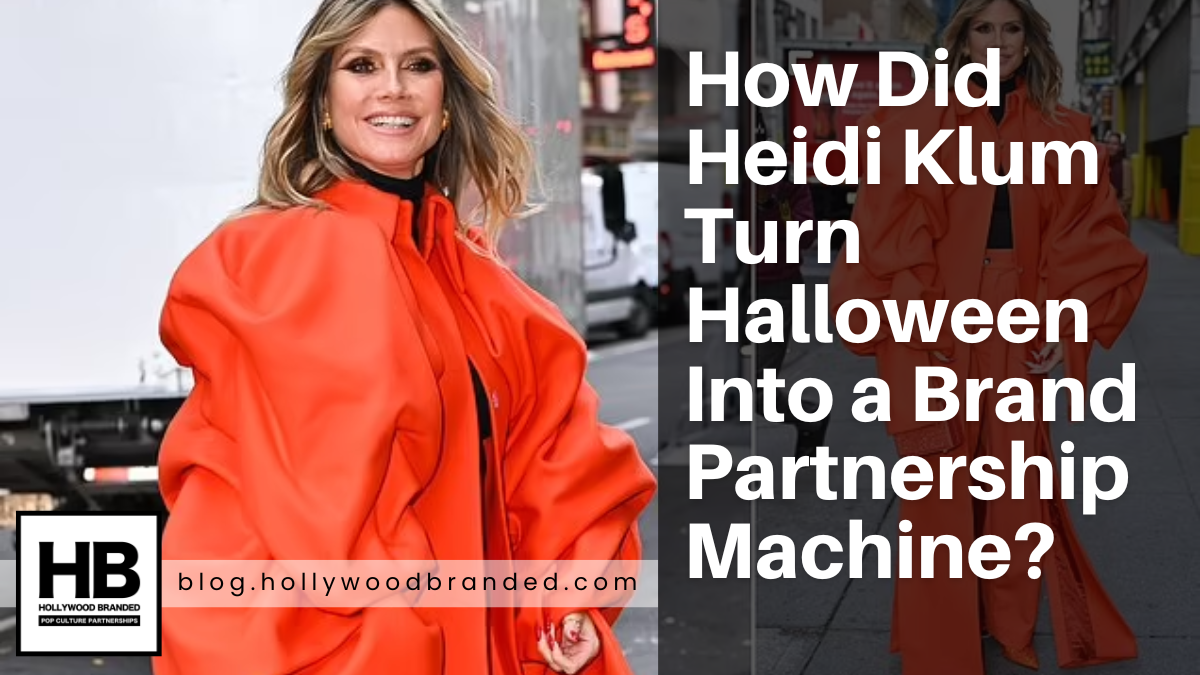
Photo Credit: DailyMail
How Did Heidi Klum Turn a Halloween Party Into a Pop Culture Franchise?
Heidi Klum didn't stumble into her Halloween reign overnight. She has thrown her annual party since 2000, skipping only 2020 and 2021 due to the COVID-19 pandemic. Klum grew up with Carnival traditions in Bergisch Gladbach, Germany, and discovered Halloween after making the United States her home. That personal connection matters, because audiences can tell when a celebrity genuinely loves what they're doing versus when they're simply showing up for a paycheck. Over more than two decades, her party evolved from a celebrity gathering into a media event that entertainment outlets cover like a red carpet premiere.
The costumes are the engine behind that growth. Past looks include Jessica Rabbit, Frankenstein's monster, and a version where five friends joined her to create six Heidi Klums. Many fans still remember her 2022 party most, when she dressed up as a giant worm. In 2023 she arrived as a peacock with nine people dressed as her tail feathers and claws, and in 2024 she and husband Tom Kaulitz both went as E.T. Each costume outdoes the one before it, which is exactly why the internet waits for the reveal every single year. What she built is not a party, it's a franchise with a release date, a loyal audience, and a guaranteed news cycle.
 Photo Credit: Getty Images
Why Do Brands Keep Sponsoring Heidi Klum's Halloween Party?
Brands follow attention, and Heidi Klum's Halloween party delivers attention on a predictable schedule. Her 2022 party was presented by Now Screaming X Prime Video and Baileys Irish Cream Liqueur, and her 2023 party was presented by Patron El Alto. The 2024 party was presented by Butterfinger, Mattel, and Prime Video, while the 2025 party at Hard Rock Hotel New York was presented by Butterfinger and Huluween on Disney+. Notice that Butterfinger came back for a second year, which tells marketers something important about the value these partners are seeing. Brands rarely renew a presenting role if the first year didn't deliver what they needed.
It's also worth being clear about what kind of partnership this is, because the terms are not interchangeable. A presenting sponsorship puts a brand's name on the event itself, so it shows up in photo captions, press coverage, and red carpet backdrops that get distributed across entertainment outlets. That's different from product placement, where a product appears inside a show or film, and different again from a promotional partnership, where a brand co-markets alongside a property with its own campaign. Klum's 2026 wine partnership appears to be its own separate deal, and the brand has not been named in the coverage we reviewed [VERIFY]. For marketers, the lesson is that one celebrity moment can support several partnership types at once, each with its own rights, deliverables, and value.
 Photo Credit: shortyawards.com
What Makes a Celebrity Tentpole Moment Worth a Brand Partnership?
The real value of Heidi Klum's Halloween party isn't one night in New York, it's the months of anticipation that lead up to it. On The Tonight Show Starring Jimmy Fallon, she said her preparation had started months earlier and even counted down the days until the party. In 2025 she shared a prosthetic of her bust on Instagram weeks before the event, and she lit the Empire State Building in celebration of Halloween the day before the party. Every tease creates another headline, and every headline is another chance for a partner to be part of the conversation. This is what a true tentpole moment looks like: a predictable date, a built-in audience, and a long runway of earned media.
The craftsmanship also gives the moment real credibility. Last year's Medusa costume took six months to develop and was made by a team of 15 people, and Klum spent 10 hours preparing her look on the day itself. On the red carpet, she told Variety that doing live art still matters amid the rise of generative AI. That point matters for brands, because audiences increasingly reward work that feels handmade, human, and authentic. After the party ends, the cycle keeps going, as she shared snapshots from the event on Instagram and signaled she'd see everyone next year. The takeaway for marketers is simple: partner with moments that have a before, a during, and an after, because each stage gives your brand another opportunity to show up.
How Can Brands Create Their Own Halloween Pop Culture Moment?
Not every brand will be the presenting partner on Heidi Klum's red carpet, and that's fine, because the underlying playbook works at many levels. Start by identifying the cultural moments your audience already cares about, whether that's a celebrity tradition, a horror franchise, a streaming platform's seasonal programming, or a creator's annual content series. Then ask whether your brand has a genuine reason to be there, because forced fits get noticed and ignored. Timing is the next piece, since the most valuable real estate in a tentpole moment is often secured months in advance. Finally, plan how you'll amplify the partnership before, during, and after the moment, rather than treating it as a single night of exposure.
At Hollywood Branded, we approach this through a repeatable system: Playbook, Radar, Unlock Access, Produce, Amplify, and Grow. That means building the strategy first, tracking the cultural opportunities that fit, securing access to the right partners, producing the activation, amplifying it across channels, and growing the results into the next season. Halloween is a natural place to put that system to work, and our team recently wrapped a Halloween activation with Govee. The horror genre itself also carries real marketing power, as research from the University of British Columbia's Sauder School of Business found that people are more likely to notice and form a personal attachment to a brand when they're scared. The brands that win Halloween are the ones that treat it as part of a long-term pop culture strategy, not a last-minute seasonal promotion.
 Photo Credit: AMC
What Should Marketers Take Away From Heidi Klum's Halloween Playbook?
Heidi Klum's Halloween party proves that consistency creates value. She built an annual moment that audiences anticipate, media outlets cover, and brands return to year after year. For marketers, the lesson isn't to copy her costumes, it's to understand why the moment works: genuine passion, a predictable schedule, a long anticipation cycle, and craftsmanship that people respect. Those same ingredients can power partnerships across celebrities, creators, films, series, and live events.
As you plan for Q4 and beyond, keep a few takeaways in mind. Look for cultural moments that repeat, because repeatable moments build recurring brand value. Know which partnership type you're actually buying, since sponsorship, integration, and promotional partnerships deliver different results. Plan early, because the best seasonal opportunities are locked in long before the calendar turns to October. And always build for Mutual Benefit, so the celebrity, the property, and your brand all walk away stronger than when they started.
 Photo Credit: Dimitrios Kambouris/Getty Images
Eager To Learn More?
If you're ready to put pop culture to work for your brand this season, these Hollywood Branded articles are a great next read.
- How Brands Leverage Halloween to Create Buzz and Boost Engagement
- Scary Good Marketing: Understanding the Horror Genre's Captivating Influence
- 5 Classic Halloween/Horror Films And The Brands They Feature
- Top Brand Partnerships For Goosebumps 2: Haunted Halloween
- Make This Holiday Season Count with Strategic Brand Partnerships
Want to stay in the know with all things pop culture? Look no further than our Hot in Hollywood newsletter! Each week, we compile a list of the most talked-about moments in the entertainment industry, all for you to enjoy!