A clothing label's jacket is suddenly the thing everyone wants, and everyone wants it for free. Today's letter comes From the Set.
✦ From the Set ✦
Dear Stacy,
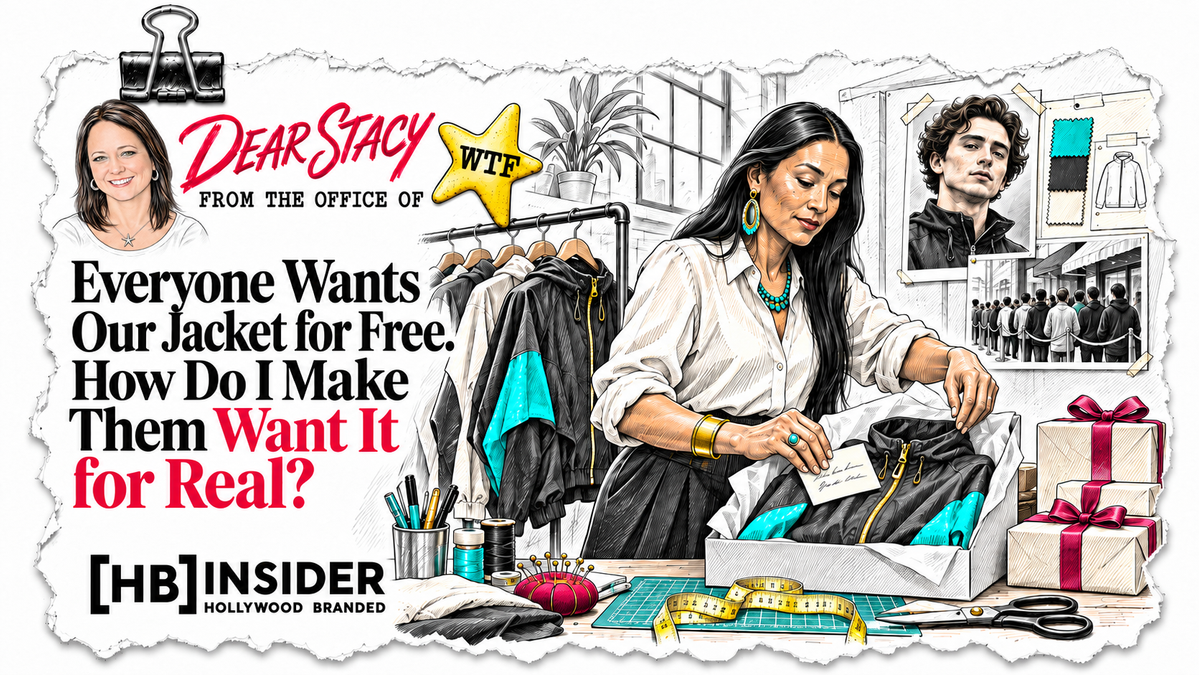
I run a small streetwear label. My DMs are full of creators offering to "rep the brand" in exchange for free product, and after reading your letter from the coffee shop owner, I know where that road goes. Then I watched a movie jacket take over my feed. Famous people in the same windbreaker, a line around the block for a pop-up, resale prices I can't type with a straight face. Nobody asked for those jackets. They were handed out. I have a marketing budget the size of a lunch order and one really good jacket. Is seeding something only movie stars can pull off, or is there a version for a label like mine?
Signed, Seedless in Silver Lake
Dear Seedless,
There is a version for you, and it starts with flipping who does the asking.
Look at the Marty Supreme jacket. Ahead of the film's Christmas Day 2025 release, Los Angeles designer Doni Nahmias made a limited windbreaker, and Timothée Chalamet reportedly hand-picked who got one, according to The Zoe Report, which cited Nahmias's comments to WWD. The people photographed in it ran from Kylie and Kendall Jenner and Hailey Bieber to Tom Brady, Steph Curry and Bill Nye. When the public got a shot, PPAI reported that the $250 jacket sold out in about 15 minutes, and a New York pop-up announced with a single Chalamet post drew a line more than five blocks long. The Zoe Report cited StockX listings above $6,000. Nothing I read says any wearer was paid, so I am treating it as gifting.
Joseph Sommer, CEO of promotional products distributor Whitestone, told PPAI the team was really handing out early access to the film's world and a sense of belonging. That is the part your label can copy. Brands buy cultural association, not screen time, and that jacket was pure association.
A freebie someone asks for is a transaction, and the person asking sets the terms. A gift you choose to send, to a short list, is a signal. The person who gets it feels picked, and everyone who sees it wants in. Passion is what makes that signal work. A handwritten note and no ask tell the person you care about the piece and about them, and people can feel when a label loves what it makes.
For a label your size:
- Make a small run of one piece just for seeding.
- Pick 15 to 20 people whose audience you actually want, and send it with a handwritten note and no posting requirement.
- Decline the inbound "free product for a post" requests.
- Open a short, limited sale once people start asking where to get it.
Some recipients will not post. That is the cost of making it feel real.
The Move
Stop answering the people who ask for free product and start choosing the people you would be proud to send it to.
The Value: Passion · Chapter: Will Post for Free Stuff
Parody letter inspired by reporting from PPAI and The Zoe Report. The letter writer is fictional.
✦ The Court of Public Perception ✦
The Score
The Marty Supreme jacket
Who fumbled: Nobody
Who won the perception game: The film's merch, gifted to a hand-picked list before anyone could buy it
The ruling: Free product works when you pick the recipient
✦ From the Office of WTF ✦
Real letters from the moment a business suddenly becomes the story, and what to do next.
Every letter comes back to owning the next choice. That is the heart of Dragons & Doors, my parable about accountability. If one of these letters felt familiar, the book goes deeper.

Stacy Jones is the founder and CEO of Hollywood Branded, a Los Angeles pop culture marketing agency, with 30 years in the business. She is the author of Dragons & Doors and hosts the Marketing Mistakes podcast.