Quick Answer
Brands think in product time, but audiences live in brand time. Here's how product placement builds brand equity that lasts for years.
What Can a Messi and Lamine Yamal Photo Teach Brands About Time?
In 2007, a young Lionel Messi posed for a UNICEF photoshoot holding a baby boy. Nineteen years later, that baby, Lamine Yamal, lined up against Messi's Argentina in the World Cup final, which Spain won.
Nobody planned, bought, or campaigned for that arc, and it still became a story people kept returning to all summer because it was real, specific, and connected across time. Most brands look at it and see a sports moment, when it is really a lesson in how brand equity compounds across the past, present, and future at the same time. In this article, Hollywood Branded discusses why brands get stuck thinking in product time instead of brand time, and how product placement builds the kind of lasting identity that advertising struggles to match.
Why Are Brands Stuck Thinking in Product Time Instead of Brand Time?
Ask the average brand team what they are building and they will describe what they are selling: the new SKU, the updated formula, the platform launch, and the campaign behind it. That is product thinking, and it moves in one direction. It resets with every new release, because the product is the hero and the story starts over whenever the product changes. The trouble is that this timeline belongs to the company, not to the people who actually experience the brand. A team can run a flawless launch and still be building nothing that carries into the next one.
Consumers experience brands in what we call brand time, and brand time does not move in a straight line. The audience watching a film today carries associations built from something they saw three years ago. A consumer who never bought the original product is forming an opinion right now based on who they believe the company is. A customer who purchased a decade ago is deciding whether to come back based on whether the brand still feels like itself. Past, present, and future are all active at once, so brands that only think about the present moment can lose ground in all three.
How Does Product Placement Work in Brand Time When Ads Can't?
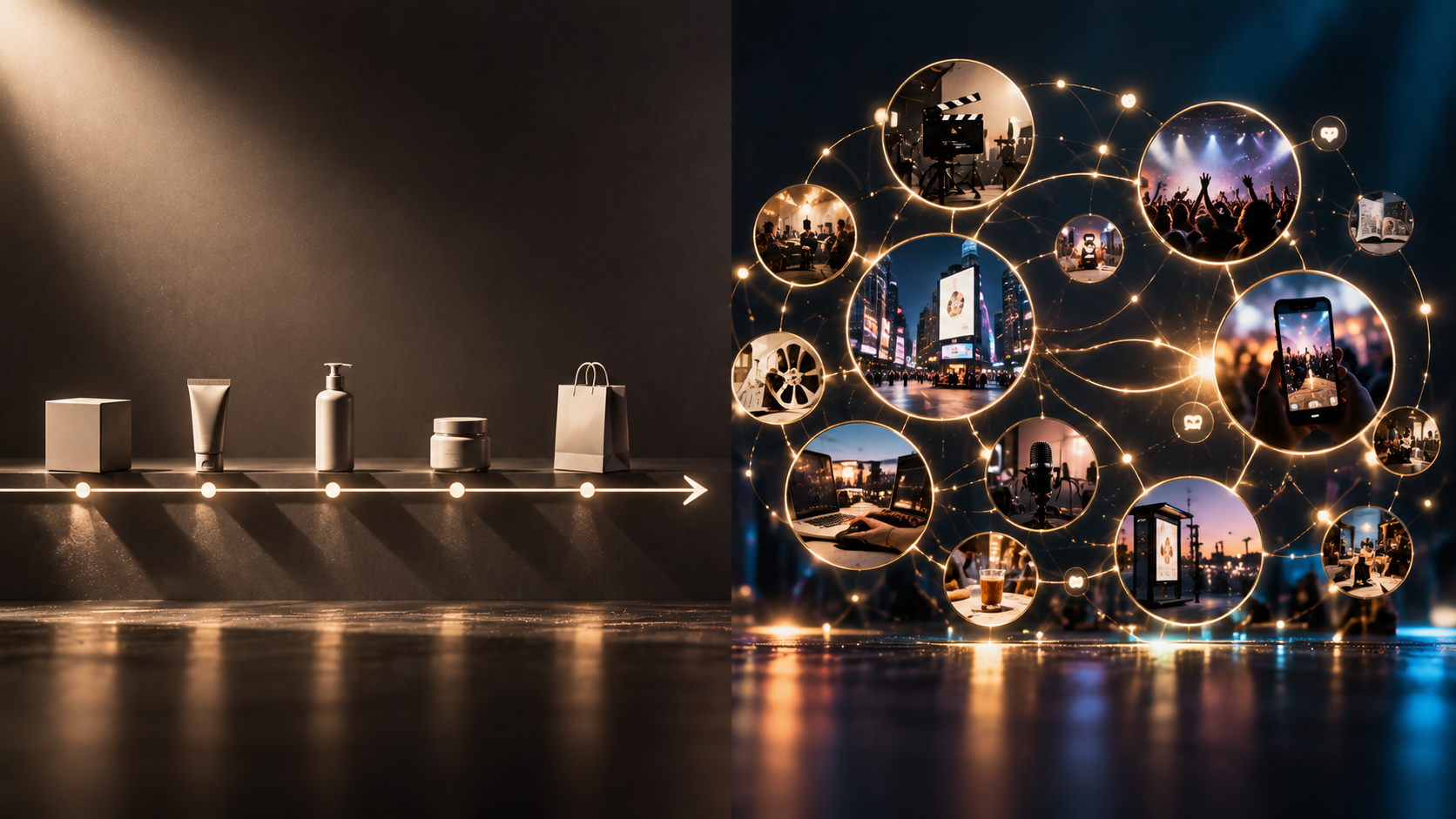
A television commercial lives in product time. It runs during a campaign window, delivers a specific message about a specific product, and disappears when the flight ends. The media buy starts over next quarter, which means the investment rarely builds on itself. A product placement behaves differently, because the scene stays in the film. The opening weekend audience sees it this fall, the streaming audience sees it next year, and viewers who discover the film years from now see the same integration, paid for once.
That is why we describe a placement as a deposit into cultural memory rather than a pitch for a product. The audience absorbs it without the resistance that advertising tends to trigger, and learns through pattern recognition that this brand belongs in this world. Ray-Ban's association with Top Gun in 1986 is a classic example. The sunglasses from that scene are not the current product, yet the identity that placement helped build still shows up for audiences watching the film today. Results vary by placement, but the principle holds: a well-integrated moment can keep working long after the campaign calendar moves on.
 Photo Credit: American Optical
Why Do Placements Keep Paying Off Long After a Brand Moves On?
It really hurts when a brand you spent a decade working with moves on from the chapter you helped build. Hollywood Branded worked with BlackBerry for roughly ten years, and our own case study materials cite more than 6.5 billion first-run impressions across that program. Then you are watching a movie or an old episode of a favorite show, and there it is, a BlackBerry in someone's hand. For most viewers, it is just part of the scene. For the people who helped design it, build it, sell it, market it, or get it onto that screen, it is personal.
"I was part of that." That feeling is a power of product placement we do not talk about enough, and it is one reason companies invest in it for internal employee morale as well as consumer reach. There is real pride in seeing your company on screen next to some of the biggest stars in Hollywood. Those moments keep reaching new audiences years after the original work is done, and they keep connecting the people who were part of the brand's story even after everyone has moved on. So for everyone who worked at or with BlackBerry, here is a nod to what you helped build. Every time those scenes play, a little piece of that chapter lives again.
Are Brands Selling the Wrong Thing in Their Entertainment Integrations?
The most common mistake we see across categories is a brand so focused on communicating product features that it never builds the identity underneath. The brief gets written around the product benefit, success gets measured by whether the product was visible, and then the question arrives: why did the integration not move the needle the way we expected?
The product is rarely what the audience remembers. What they remember is the feeling the brand created inside that world, including the confidence it projected, the lifestyle it sat inside, and the character who reached for it without explanation, as if there were no other choice.
That feeling is brand identity doing its job, and it is what transfers to the shelf, the website, and the purchase decision made three months later, when a consumer cannot recall where they first saw the brand but knows it belongs. Product placement is about more than an instant sale. It is about building a legacy that keeps delivering, which is what good brand advertising is supposed to do in the first place. Brands that brief their integrations around identity first, and product second, give the audience something worth remembering. Brands that brief around inventory give the audience a logo.

What Should Brands Build Today That They'll Be Grateful for Later?
No brand planned the Messi and Yamal photograph, and no agency pitched it. The brands that were already inside Messi's story did not need to manufacture a moment, because their past investment connected to the present payoff and the next chapter all at once. That is what brand time looks like when it works, and it is available to brands in every category, not just sports or entertainment. The brands building their own version of that photograph right now are rarely the ones running the biggest campaigns. They are the ones placing their identity inside stories that are still growing, and committing to partnerships without an obvious immediate return.
Here is the practical takeaway for marketers. Lead with who your brand is, not what you are selling this quarter, because the product is what you sell this year and the brand is what makes people want whatever you sell next. Build your entertainment integration strategy around identity first by asking what world your brand belongs in, what character would naturally reach for your product, and what story would teach an audience who you are.
Eager To Learn More?
If this look at brand time and lasting placement value was useful, these related reads dig deeper into how product placement builds brand identity that lasts.
- The Hidden Value of Product Placement
- How Hollywood Branded Integrated BlackBerry into Sex and the City
- Product Placement Case Study: Secrets To Securing Trade Out Opportunities In Hollywood
- BlackBerry Product Placement Success Reported By Fans
- Why Pop Culture Is Where Brand Relevance Is Earned
Want to stay in the know with all things pop culture? Look no further than our Hot in Hollywood newsletter! Each week, we compile a list of the most talked-about moments in the entertainment industry, all for you to enjoy!