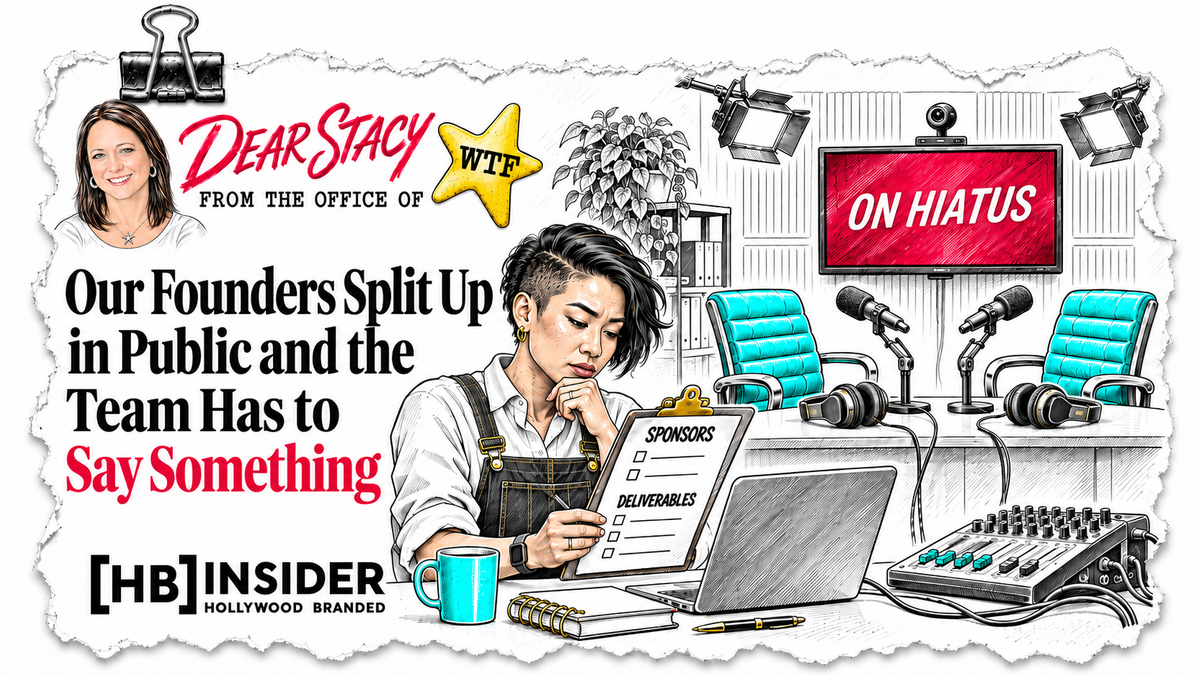
A creator company's founders split up in public, and the crew is left answering sponsors and fans. Today's letter is about who speaks for the business when the founders are the story.
When the Founders Are the Story
Dear Stacy,
I'm a producer at a small creator company owned by a married couple. They host the show and they sign our checks. Last week one of them announced the show was going on hiatus. Hours later the other posted that they had separated and made a serious allegation about the marriage. Our inbox is full of sponsors asking what happens next and fans asking where the crew stands. Half the team wants to post a statement tonight. The other half wants to say nothing. None of us knows who actually controls the channel. What should we do, and what should we say?
Signed, Caught in the Middle of the Mic
Dear Caught,
Slow down for one day. Get clear answers on who controls the accounts and the money, then speak to sponsors privately before you speak to the public. Whatever you post, keep it about the work and the people on your team.
The closest real example is the H3 Podcast. Ethan and Hila Klein started H3H3 Productions on YouTube in 2011 and launched the H3 Podcast in 2016, which has 5.4 million subscribers, according to Yahoo (Kelsey Weekman, October 23, 2026). In October 2026, Ethan posted that the podcast was going on indefinite hiatus. Hours later, Hila posted that they had separated and publicly said Ethan had an affair. Ethan had not publicly responded in the coverage I saw. The production crew posted that they stand with Hila and agreed they would not continue working with Ethan involved or profiting, while saying they did not yet know what that means for the future. Yahoo said it had reached out to the parties for comment.
This is a painful situation for a family, and the personal side belongs to them. The business side applies to any company built around a couple.
In a couple-owned business, the founders are the key-person risk. When their relationship changes, every open question about ownership, account access, sponsor contracts and approvals arrives at once. If nobody at your company has written those answers down, that is the first job.
Put these in place before anyone needs them:
- Clear ownership records for the company, the channel, the brand and the accounts.
- A written founder-exit plan that covers the show, the staff and sponsor obligations if one founder steps away.
- One approved spokesperson for the business, separate from anyone's personal account.
- A sponsor sheet of every deliverable and date, so staff can answer partners on their own.
Your sponsors are guessing right now, and a partner who knows what is happening forgives a lot more than one who is guessing. Clear Communication is the standard I would hold your team to this week, and it covers the work only.
Today, tell sponsors what you know about deliverables and timing. Tell the audience only what you can stand behind.
The Move
Write down who owns what and who speaks for the business while everyone still gets along.
The Value: Clear Communication · Chapter: When the Founders Are the Story
Parody letter inspired by reporting from Yahoo (Kelsey Weekman, October 23, 2026). The letter writer is fictional.
✦ The Court of Public Perception ✦
The Score
The H3 Podcast hiatus and separation
Who fumbled: Too early to say, and not ours to judge
Who won the perception game: Nobody, it is a painful situation
The ruling: Couple-owned companies need ownership and exit plans in writing
✦ From the Office of WTF ✦
Real letters from the moment a business suddenly becomes the story, and what to do next.
Every letter comes back to owning the next choice. That is the heart of Dragons & Doors, my parable about accountability. If one of these letters felt familiar, the book goes deeper.

Stacy Jones is the founder and CEO of Hollywood Branded, a Los Angeles pop culture marketing agency, with 30 years in the business. She is the author of Dragons & Doors and hosts the Marketing Mistakes podcast.