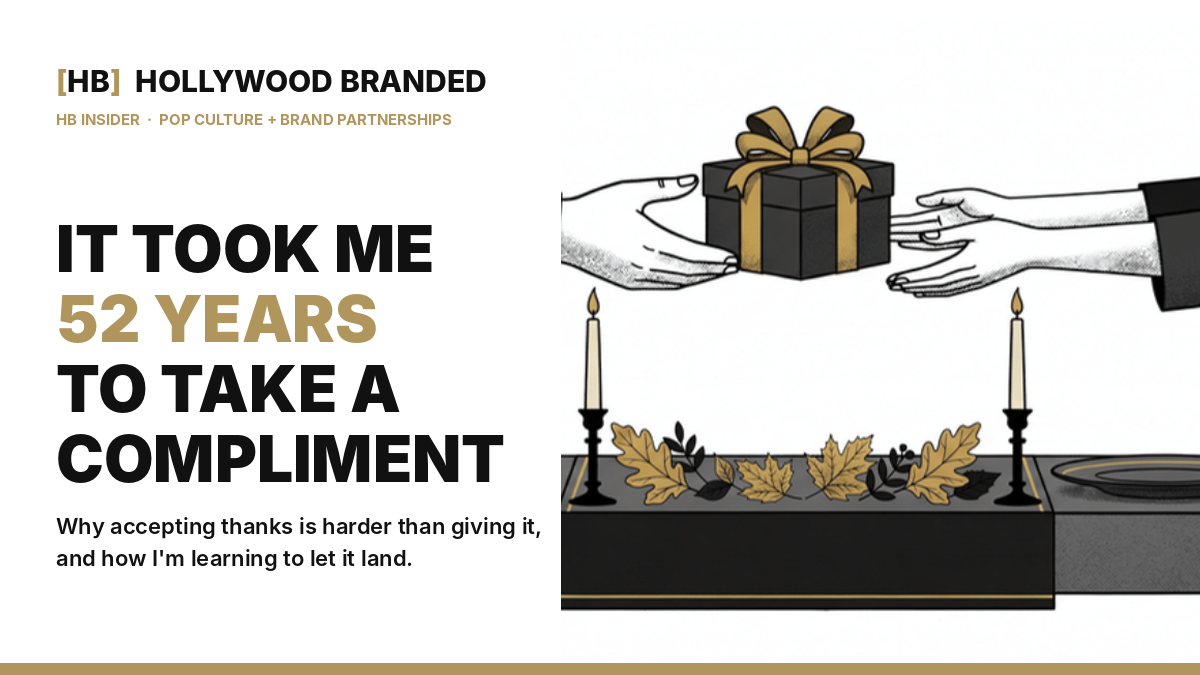
I fight compliments. Every time.
It's Thanksgiving week, which means a lot of us are about to sit around a table and say what we're grateful for. I'm good at that part. I can rattle off the people, the team, the clients and the partners who've made my life better without missing a beat. Where I fall apart is the other side of thanks, the moment someone turns it around and says it to me.
I'm 52 years old, and I'm only now learning how to take a compliment. Most of the time I still fail at it. In this article, Hollywood Branded shares why accepting thanks can be harder than giving it, how a pattern seeker learns to see her own wins and what it takes to finally let a compliment land.
Why Does a Compliment Feel So Uncomfortable?
Someone tells me I did something great, or that I inspired them, and I feel it physically. My shoulders go up, I want to change the subject, and my brain immediately starts building the case for why they're wrong.
I get told I inspire people a lot. After a talk, in a DM, sometimes from someone on my own team. I'm grateful every single time, and I'm also squirming every single time. It's taken me five decades to figure out why, and to start working through the patterns I put in place to block those compliments before they could land.
Because here's what happens when someone says something kind. My brain pulls up a list of everything I haven't done yet. The goals still sitting there, the calls I'd make differently, the places I fell short. When I look at myself, the first thing I see is where I'm not. Only once in a while, when I've actually done the work, does a compliment get through and hit home. That happens when I stop and let myself see me through someone else's eyes, which is something most of us are terrible at.
I bet you can relate. Maybe your boss says you crushed the presentation and all you can think about is the slide you stumbled on. Or a friend tells you you're a great parent and your mind goes straight to the morning you lost your temper. We're quick to give everyone else credit and slow to keep any for ourselves. If that sounds like you, keep reading, because this one's for both of us.
Why I see the gaps first
I'm an empath, a pattern seeker and a disruptor, and those traits have shaped my whole career. They also explain a lot about why I see myself the way I do.
A pattern seeker is always scanning. I walk into a brand meeting or onto a set and I notice what's off, what's missing and what could work better. That's a big part of why I've lasted 30 years in this business. It's how I find the opportunity nobody else is looking at, and it's why I can't leave well enough alone. The catch is that the scanner never shuts off, including when I look in the mirror. The same instinct that finds the hole in a marketing plan finds every hole in me.
The empath side shows up in a way people don't always expect. I don't see myself as any different from anyone else. I don't think of my achievements as bigger than someone else's life, and I don't size people up by their status, their religion or their race. None of that factors in when I compare one person to another. What I judge is drive, passion, accountability and resilience.
I'm an eternal optimist, and I believe anyone can become whoever they want to be. The problem is that most of us don't know who that is, because when you're in the middle of it, all you see is the moment you're in. So when someone tells me I inspired them, it doesn't quite compute. In my head I'm just another person doing the work, same as them.
I have been told otherwise. Over and over again. So I decided to look at my own patterns and failures and successes and identify what it was that others saw that I could not self identify. And that is when my journey began that led to 60 pounds of weight loss and a new balance to my life that seemingly is paying off. And it all began when I was sitting outside after weeks of meditation.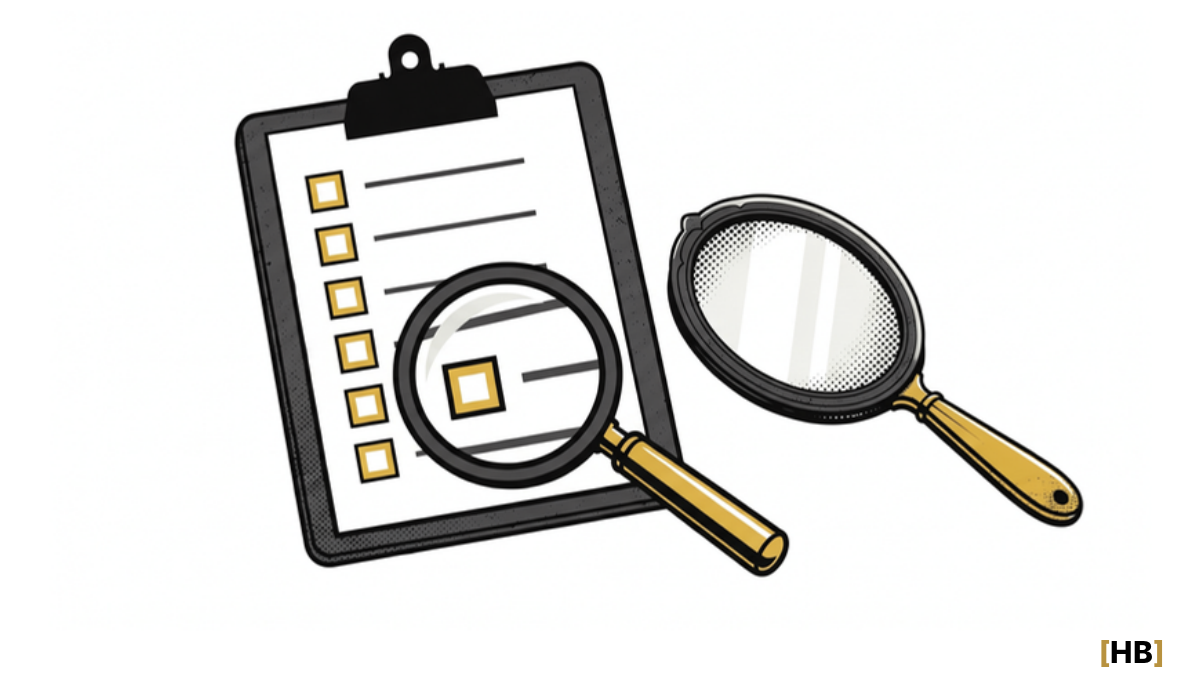
What Happens When You Keep Score of Your Wins and Fails?
So I've been doing something about it. I've sat down and actually tallied it up. My wins, my fails, the things I tried that worked and the things that blew up in my face. There's a reason therapists and coaches tell you to keep lists, and as a pattern seeker it turns out I needed to see my own patterns written down before I'd believe them.
When it's on paper, the fails don't get to be the only thing in the room. The wins are sitting right there next to them, and some of them are pretty big. And the more I looked at that list, the more I started to understand why so many of my struggles had nothing to do with not trying hard enough.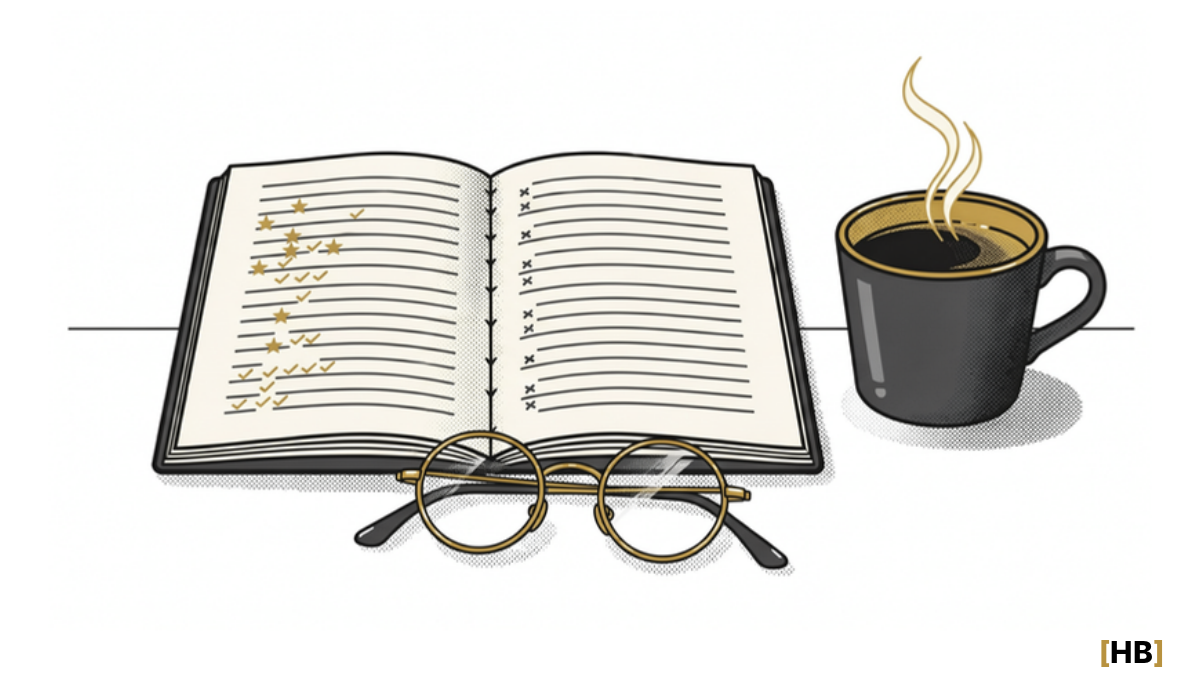
What Are the Three Ways We See Ourselves?
Here's how I've come to think about it. There's the you who's nose to the ground, trudging forward, kicking and pushing through the ups and downs of life. That version of you only sees the moment it's in and has almost no perspective on the bigger picture.
Then there's the you that other people see when they step back and look at your situation. That person often looks nothing like the one in your head. It's odd, and it's hard to reconcile, because neither view has the real story. The version running in your head is incomplete, and so is the one other people see.
The third view is the one I'm always working toward. It's the you who can step outside both, look at the situation clearly from every side and angle, and see it impartially. There are levels to that, and it takes work. For me, getting there is what meditation is for, and it's the whole point of growing your self-awareness. Every layer you reach unlocks another door.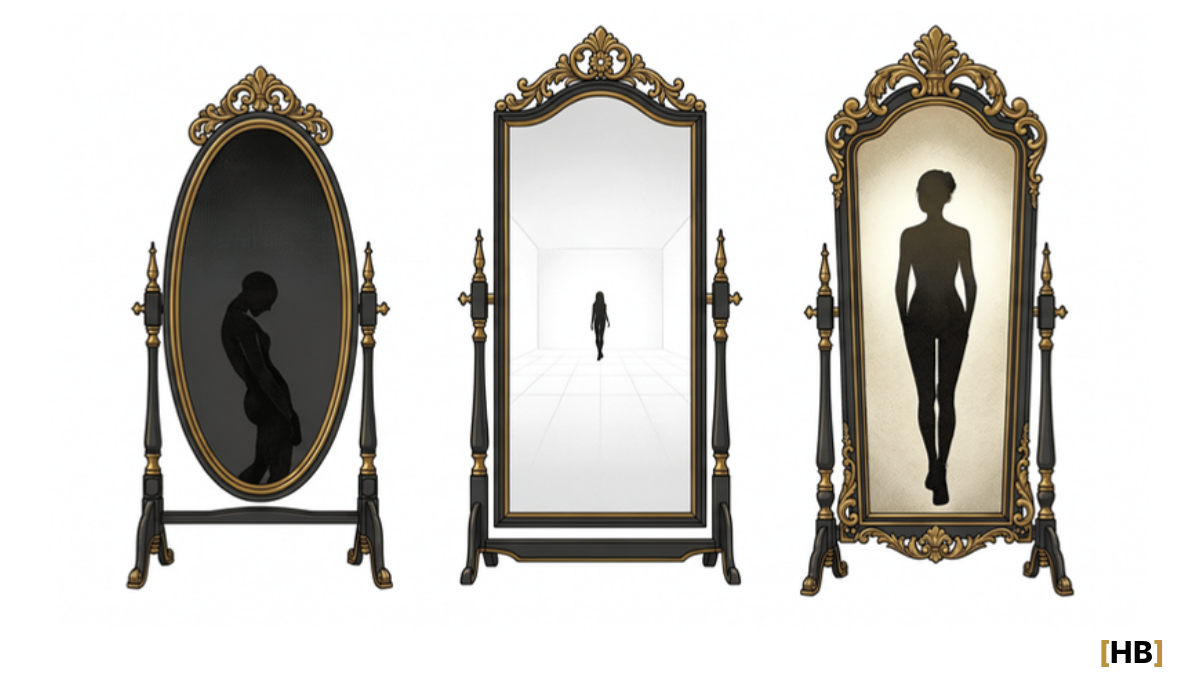
How Do You Let a Compliment Land?
I'm a helper by nature. I'll compliment a total stranger in an elevator, make the intro, give away the advice and show up for whoever needs it. Giving is easy for me. Receiving is the part I'm still learning, and what finally clicked is that a compliment is someone giving me something. When I wave it off or argue with it in my head, I'm turning down their gift.
So I'm practicing. I say thank you, I mean it, and I stop talking. No disclaimer, no list of everything I still have left to do. I'm not great at it yet. Ask me again in a year.
What Can Dragons & Doors Teach Us About Seeing Ourselves Clearly?
When I wrote Dragons & Doors, I was writing about the challenges we face and the choices that move us forward. I didn't fully realize how much of that journey is about learning to see clearly, including the doors you've already walked through without ever giving yourself credit.
If you're someone who sees where you're not before you see where you are, here's what's been working for me.
- Make the list. Write down your wins and your fails side by side. Seeing them together changes the math.
- Take the compliment. The next time someone tells you that you helped or inspired them, say thank you and stop there. It will feel awful. Do it anyway.
So this Thanksgiving, I'm going to practice both halves. I'll thank the people who helped me get here, and when someone thanks me back, I'm going to let it land. I'm 52, and I'm still working on all of it. If you've figured out how to take a compliment without flinching, reply and tell me how you did it. I promise I'll say thank you.
Eager To Learn More?
Want more of the lessons behind building a brand and a business? These Hollywood Branded articles are a great place to start:
- Dragons and Doors: The Book That Took 18 Years to Write Itself
- The Unscripted Path: Building Hollywood Branded Against All Odds
- From Lemonade Stands to Hollywood: The Unconventional Path of a Maverick Female Entrepreneur
- How Does Entertainment Make the World Bigger for Older Audiences?
- What Can a Gilded Age Penny Teach Hollywood About Brand Partnerships?
Want first look at what's hot in Hollywood? Get our free Hot In Hollywood email for the productions we represent, upcoming event seasons, film releases, turnkey agency programs and last-minute amplification opportunities, or enroll free in [HB]Box. Pick your way in below.


Stacy Jones, Hollywood Branded's Founder and CEO, has over thirty years of leadership experience building global entertainment branding campaigns for Fortune 500 companies and hundreds of brands. Her career started after receiving her BFA in Theater Production and Scenic Design from the University of Arizona. Acknowledged as an expert in the field, she has appeared on CNN and MSNBC, spoken at conferences around the globe from Germany to Beijing, and been featured in BBC World News, Forbes, The Wall Street Journal, The Hollywood Reporter, Financial Times, The Economist, Brandweek, Advertising Age, Variety, B&C, and Mediaweek, and most top media outlets throughout the world. Stacy is also the author of Dragons & Doors: The Path To Creating You, a book on accountability, resilience, and the decisions that actually move a business or a career forward. It's the same philosophy she brings to running Hollywood Branded: face the dragon, open the door anyway. Originally from Texas, you'll still hear her "y'all" as she gathers the team for strategy planning sessions. Like all true entrepreneurs, Stacy is an adventurer at her core, having skydived, hang glided off biplanes, swam with crocodiles while rafting the Zambezi in Africa, photographed grizzly bears in Alaska, trekked Mayan ruins in Belize, and explored the ocean as an avid scuba diver. These days, she loves running an agency where she swims with a different kind of Hollywood shark on a daily basis, and spends as much time outdoors as she can with her husband and partner Ian, their dogs Luna and Indy, turtle Jabba, and the 100+ fish in her backyard pond, where the fish are convinced Jabba is the real shark.